

When I was in college, I worked as a server in the grille room at a golf club. I was never one of those servers who could remember an entire order without writing it down.
You know the type. No notepad. No hesitation. They just get it right.
That always amazed me. Because I am not that person.
Even now, I still have to write things down if I want to remember them.
What’s interesting, though, is that I am a visual learner. I can picture a moment, a conversation, a story, and recall it pretty clearly. I think that’s what helped me for years in broadcast journalism. When you’re live, you don’t get a second take. You have to trust your mind to organize and deliver in real time.
But behind the scenes, I was always organizing information more than people probably realized.
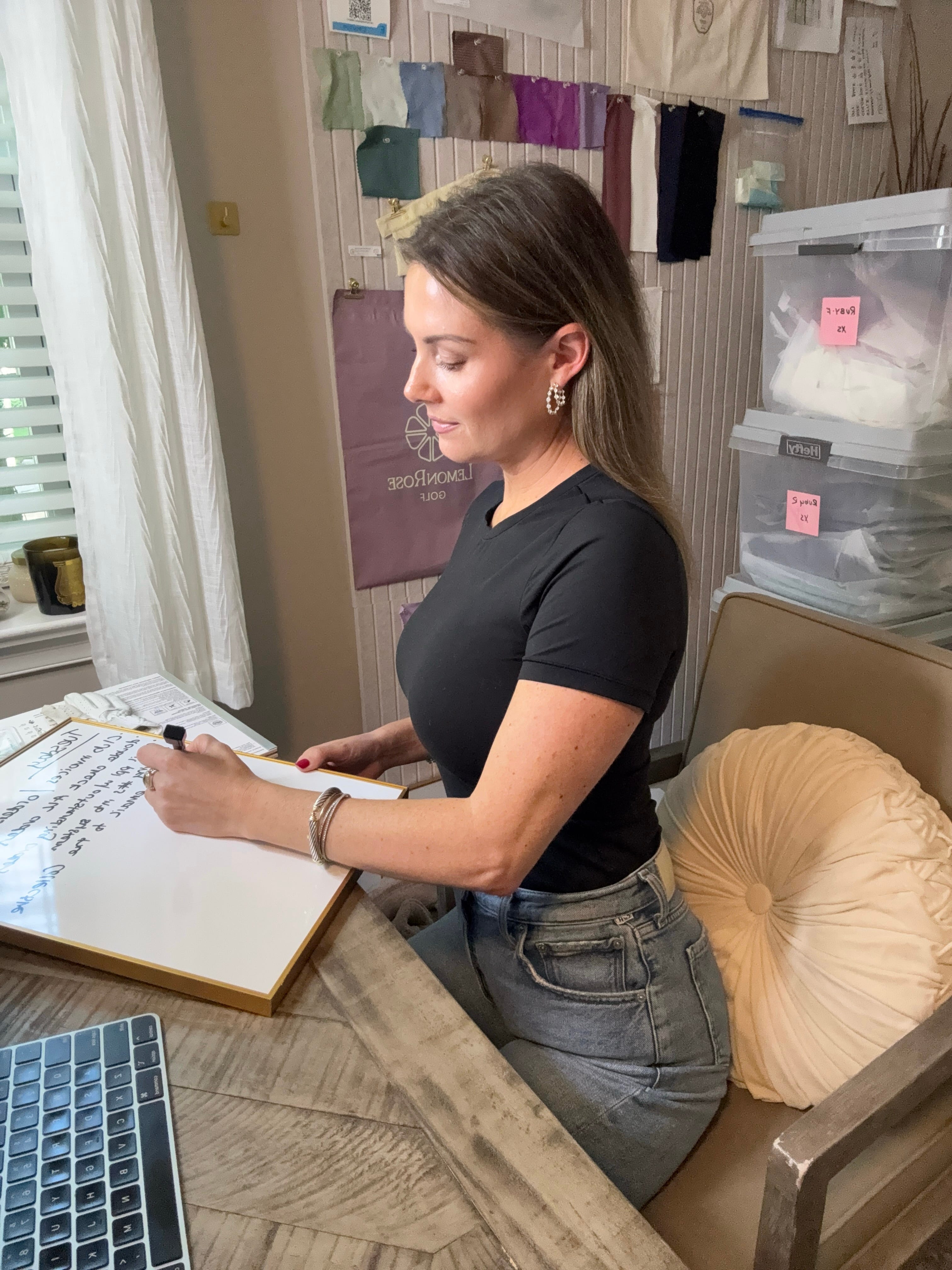
My system isn’t pretty. It just works.
These days, I’m a list person.
If I go to sleep with a running list in my head and don’t write it down, I won’t sleep well. And I definitely won’t remember everything the next day. So I’ve gotten into the habit of capturing thoughts as they come. Random moments. Late at night. In between things.
My notes app is filled with half-finished lists, ideas, reminders. It’s not pretty, but it works.
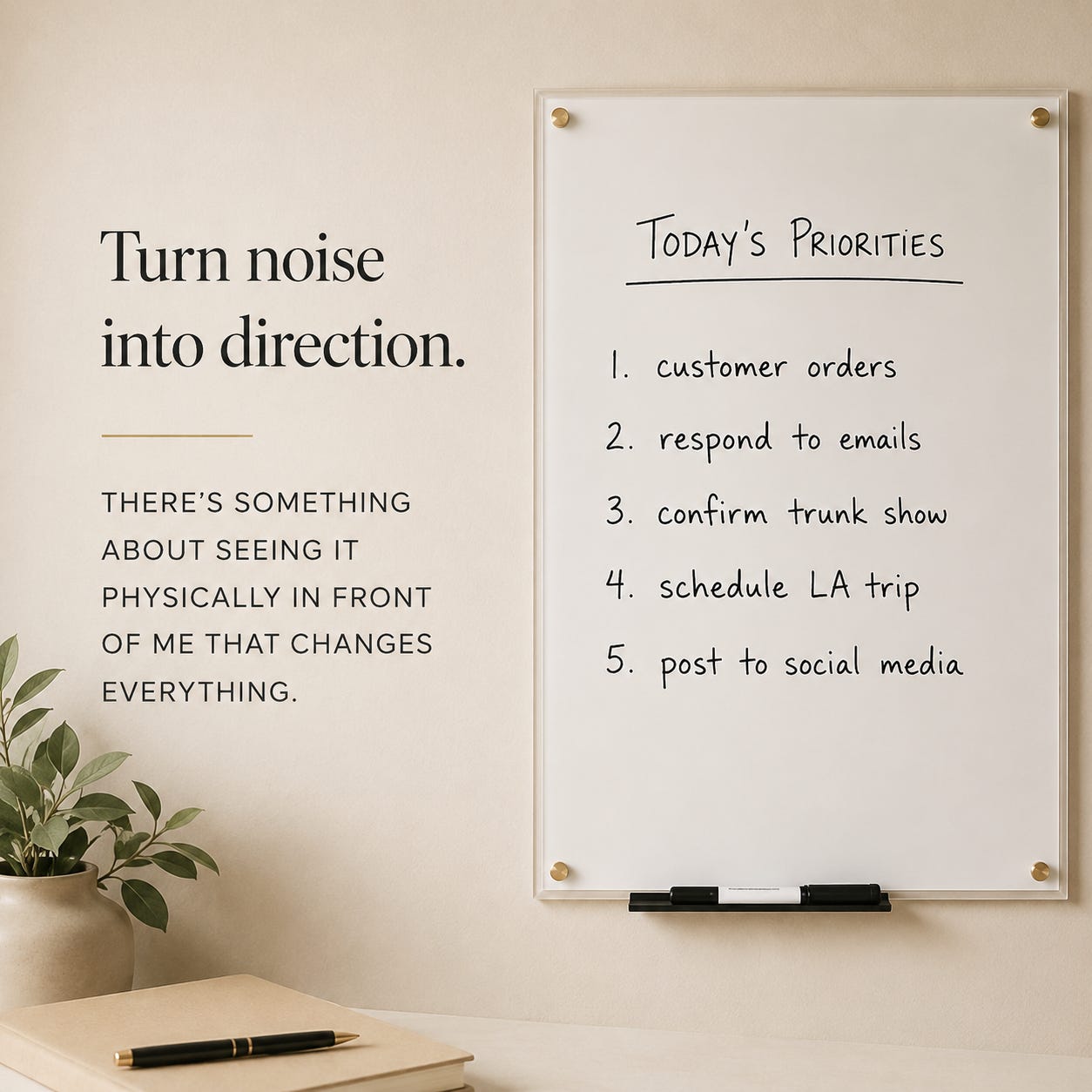
Every morning, when I sit down at my desk, I transfer what matters onto my whiteboard. In order. By priority.
There’s something about seeing it physically in front of me that changes everything. It takes what’s been swirling in my head and gives it structure. It turns noise into direction.
And then, throughout the day, I erase. Sometimes I cross things off instead, just so I can see the progress building. There’s something satisfying about that. Watching progress happen in real time.
I’ve thought about finding a better system. Something more streamlined. More efficient. Maybe more polished.
But the truth is, this works. Not because it’s perfect, but because it creates clarity.


What I’ve actually learned about my own mind
Your mind is not meant to hold everything. It is meant to process it.
The goal isn’t to manage your time better. It’s to manage your mind better.
Because when your mind is constantly trying to hold everything, it doesn’t have the space to actually think.
In fast-paced environments, whether it was live TV or now building a business, I’ve learned that the people who perform at a high level are not the ones holding everything in their heads. They’re the ones who know how to organize what matters and clear what doesn’t.
That’s what allows them to focus on what’s right in front of them. To process information more effectively. To solve problems more clearly. To make better decisions. And to respond quicker, without the noise.
The strategy hiding in plain sight
I jot things down when they come to mind, when they’re not meant to be solved in that moment. Then I release them, so they’re not taking up space at a time that isn’t best suited for them to be there.
Later, when I’m at my desk, I organize it. Prioritize it. Complete it.
But in between those moments, I’m not carrying it.
I think what this is really about is mental space.
It’s about setting yourself up in a way that allows you to actually relax and be present in the parts of life that matter most. Dinner with family. A vacation. A game. A round of golf. The moments that are supposed to be enjoyed..
Because lately, I’ve had the opposite. I’ve had nights where I’m lying in bed, exhausted, but my mind won’t stop racing. Replaying everything. Grabbing onto random thoughts. That feeling of I have to remember that looping over and over again.
All it leads to is lost sleep and a very cluttered brain.
I remember my mom telling me she keeps a notepad next to her bed. If something pops into her mind, she writes it down quickly so it doesn’t take over.
At the time, I thought it was just a habit. Now I realize it is a strategy.
What you really lose when you carry too much
When you don’t have a place to put your thoughts, they don’t disappear. They stay with you. They follow you into moments that have nothing to do with work or responsibility.
And over time, that creates something bigger.
It creates overwhelm. It makes it harder to focus. It pulls you out of the present.
I don’t think we show up as the best version of ourselves when we’re constantly carrying everything at once.
For me, writing things down isn’t just about staying organized. It’s about creating space.
Space to think clearly. Space to be present. Space to actually feel calm.
Because the version of you that’s trying to remember everything is not the same version of you that’s fully present.
Jillian, this felt especially relatable because so much overwhelm begins when the mind keeps trying to carry what would be better organized outside of it. Your line that the mind is meant to process, not hold everything, offers a simple but compassionate reframe for people who quietly confuse constant mental storage with responsibility. I also appreciated how you connected structure to presence, because creating space is often about more than productivity; it can be about rest, clarity, and being fully available for the parts of life that matter most. Thank you for sharing this with such practicality and humanity.
Love this!
As a busy, working professional and mom of two littles (well, I called them little at age 7 and 11) there is no way I could keep afloat and feel healthy in my mind without daily journaling, list making and prioritizing. I’m especially cognizant about structuring my priorities to my values.